New Zealand Plants: The world's most intriguing flora.


80 million years of isolation has led to the evolution of New Zealand's native plants with forms and characteristics that can be recognised as distinctly New Zealand plant features.
Many New Zealanders don't recognise the special feature of their native plants. It is a case of not seeing the wood for the trees. We are so familiar with flax, cabbage trees, rimu and all the others, that we forget the special place our native plants hold on a world scene. Their beauty and splendour of form can be reduced by their familiarity. New Zealand plants are unique. In their variety; and in the way they texture the landscape and create the natural and pure ambience that is New Zealand.
A New Zealand heritage and culture exists around the plants, their uses and their images; both visual and figurative. The plants help define who we are, what we do, and when and where we do it. We snooze in the shade of a Pohutukawa at the beach, wait for the kowhai to flower in spring, drink kawakawa tea when unwell, decorate our houses with toetoe, flax and cabbage trees, support the Silver Ferns and create objects from rimu, kauri, and totara.
On the world botanical stage, New Zealand plants possess a variety of unique features. Divarication, juvenile forms, dioecious or seperate gender on separate trees, a profusion of small white flowers and an immense variety of plants. These are all characteristics that could be described as the special features of New Zealand Native plants.
high percentage of endemic plants
few annual herbs and grasses
many have berries or drupes dispersed by birds
very few have defences against mammalian browsers however, they have strategies for defence against browsing birds such as Moa and other flightless birds.
many dioecious species, with separate male and female trees
many flowers are typically small and white
many plants have divaricating growth forms
a significant number have distinctive juvenile and adult forms.
A significant number show plasticity, where shape of leaf or form of plant changes dependent upon the environment the plant survives in and in some species leaf shape and form of habit changes on the same branch and between members closely growing together.
many plants have evolved into a larger forms compared with similar plant families in other countries and to compound this many plants of the offshore islands also show larger forms
Hybridism is common and in some genera the delimiting of species is difficult.
regional hotspots of biological diversity
Unique growth forms and anomalies.
Ancient remnants that have become extinct in other areas have survived in New Zealand
majority are evergreen and there are few cold-tolerant trees
The number of species increases from South to North with 3 significant latitude boundaries, to which many species range in their southern boundary. Line from Banks Peninsula to Westport ; Line from Cook Strait/Nelson, Marlborough Sounds and latitude 38 Opotiki to Kawhia.

Coprosma lucida female 
Coprosma lucida male | Dioecious plants.
One of the intriguing features of the New Zealand flora is the high percentage of plants that have separate male and female individuals. While this is the norm in animals, plants that have male and female sex organs on different individuals is unusual.
Male flowers are those whose gametes (pollen) leave the flower, while female flowers are those whose gametes (ova) remain in the flower and are receptive to the male gamete.When the flowers are on separate trees it is termed dioecious
Exotic plants that this occurs in include Kiwi fruit and Cannabis sativa which have male and female plants. A characteristic of the The New Zealand flora is the high % of plants that have the sexes on separate plants (dioecious). Approx 12-13% of our flora are dioecious. (Britain 2-5%, South Australia, 3.9%., Hawaii 5%). However in many plant association's in the forest there may be up to 50% of the individuals that exhibit dioeciousness
Dioeciousness of plants account for the variability in seeding from year to year that some species exhibit. Seeding will be determined by synchronising the time at which the male and female parts are functional. Rimu may go 7-12 years before seed on females is produced in abundance. These years are termed mast years.
As a male tree may be some distance from a female tree, the environmental conditions that determine flowering would be more variable in separate trees than the same tree. There is more likelihood of reproductive failure if the nearest tree of the opposite sex is some distance away. The fact that pollen from a distant tree must fertilise a female tree may put the successful reproduction and production of viable seed under stress. Logging of a population, and a reduction in total density of the adult trees and total gamete production will reduce the likelihood of fertilisation . This seems to be the case in Monoao( Dacrydium kirkii), a dioecious species of conifer that grows in Northlands kauiri forests.Monoao has become relatively rare in the wild with its natural range vastly reduced to remnant populations in Coromandel, Northland and Little Barrier Island.
A feature related to separate male and female trees is sexual dimorphism. This is that male plants have different form or shape than females. Of course in most animals this is obvious with the male having a different body shape to females. In plants however it is less obvious but does exist. Male Coprosma show broader leaves to female Coprosma. |
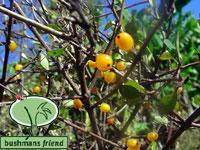 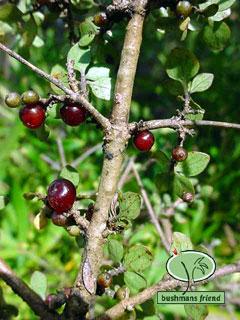
| Divarication or filiramulate A curious feature is the large number of shrubs with small leaves and flexible interlacing branches. This form is termed divarication or filliforme.
Divarication occurs across many plant families and is found in some genera or species, but may not be prevalent in all the members of the genera.
One idea put forward to explain the prevalence of this form is that it is a defensive mechanism against browsing Moa. Moa did not browse in the same way as other mammal browsers (of which New Zealand had none). Small leaved woody tangled shrubs were unpalatable to Moa, so plants with this divaricating form were successful and reproduced.
Another theory is that this shape is advantageous in a dry, cold, windy, environment as may have been present in New Zealand in a previous ice age or, this twisted small leaved form creates an ideal habitat for lizards which are the primary agent of fruit and seed dispersal. The lizards are readily able to climb throughout the plant to digest the fruit and are hidden from predators or the interwoven branches. Some species are divaricating as juveniles but adopt a more regular leaf and branching habit as adults e.g. totara and matai Divaricating plants |
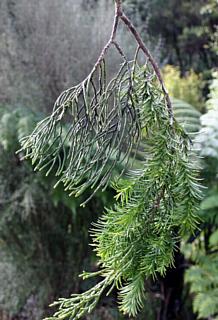
Dacrydium kirkkii monoao showing both juvenile and adult foliage on the same branch. | Juvenile & Adult forms Juvenile and adult forms are one of the most intriguing features of New Zealand plants. The juvenile has a leaf quite different in shape from the adult. The advantage of this feature is the juvenile leaves are best adapted to an environment close to the ground where the leaf may be in shade or be food for browsing herbivores (suggested to be the Moa and othere flightless extinct birds), while the adult leaf on a tall trunk may now be in full sunlight where its shape maximises photosynthesis opportunities for the energy rich processes necessary for successful reproduction. |
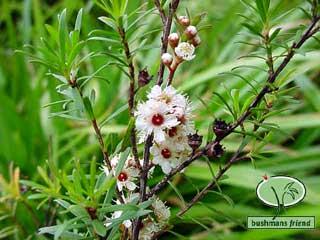 Kanuka Kunzea ericoides flowers in early summer. | Small white inconspicuous flowers on many species are attractive to pollination by small insects such as bees and ants. The white petals act as solar collectors creating a warm microclimate that encourages the small insect to visit on a chilly morning. |
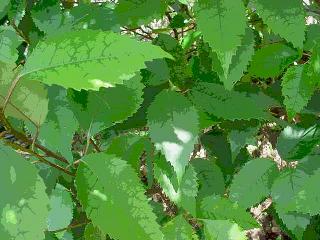 Hoheria populnea loses its leaves over winter. | Evergreen and lack of deciduous plants Only 11 new Zealand species completely lose their leaves over winter including Sophora kowhai, hoheria lacebark and kotukutuku tree Fuchsia. In Northland these species are only deciduous for a week or two and in Southland they may be deciduous for the 4 months of winter. The other trees and shrubs hold leaves for all the year. |
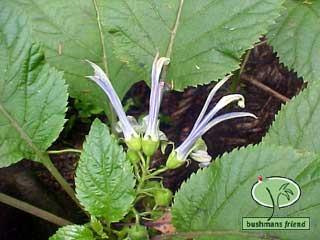
Colensoa physaloides is an attractive shrub limited in its natural distribution to Whangarei north 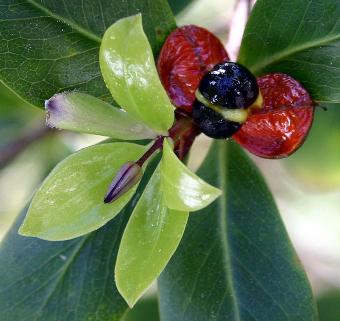
Pittosporum cornifolium an epiphyte of Northern forests. The capsule.presents the sticky seeds to birds for dispersal. Pittosporum literally translates to sticky seeds. | Regional biological hotspots that lead to plant diversity. The present day distribution of native plants is due to past climatic and geological processes. The New Zealand landmass has existed in isolation from other landmasses for 80 million years which has led to forms and species uniquely adapted to the environment of these islands. Over time New Zealand has been a cluster of islands joining and dispersing , as sea level rise and lower creating islands of isolation or broader combined landmasses.. New Zealand has the wet west side and the drier eastside while ranging into the subtropics in the north to the sub Antarctic in the south and the geological uplift created by tectonic plates colliding leads to rock and soil types changing over short distances. From the mountains to the coast, the New Zealand landscape is broken, variable and diverse. These factors create a range of microclimates to which a range of plants are best adapted. Now we find hotspots of plant biodiversity such as North West Nelson, The Three Kings and the offshore Northland Islands, along with Hokianga and Whangaroa. Each of these areas posses plants endemic to their area. In fact every province in New Zealand will have plants limited to their local distribution. |
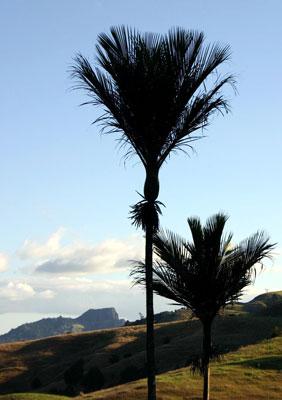 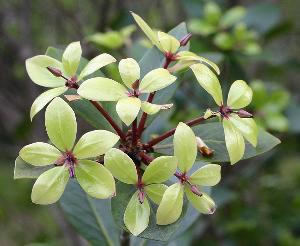
Pittosporum cornifolium | Special features New Zealand’s unique plant forms or plants with their headquarters in New Zealand. Cordyline Cabbage trees Phormuim Flax, Tree ferns Ponga Nothofagus beech Kauri the northern aristocrat Nikau the southern most palm Pittosporum, Hebe, Carmichaelia leafless broom Pseudopanax. Five fingers Coprosma 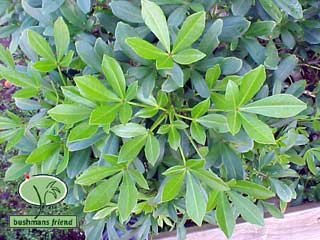
The attractive foliage and wide range of form have made these genera the plants of choice to instil a native element within ornamental gardens. 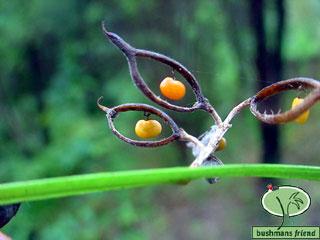
Carmichaelia leafless broom. Seed and pod |